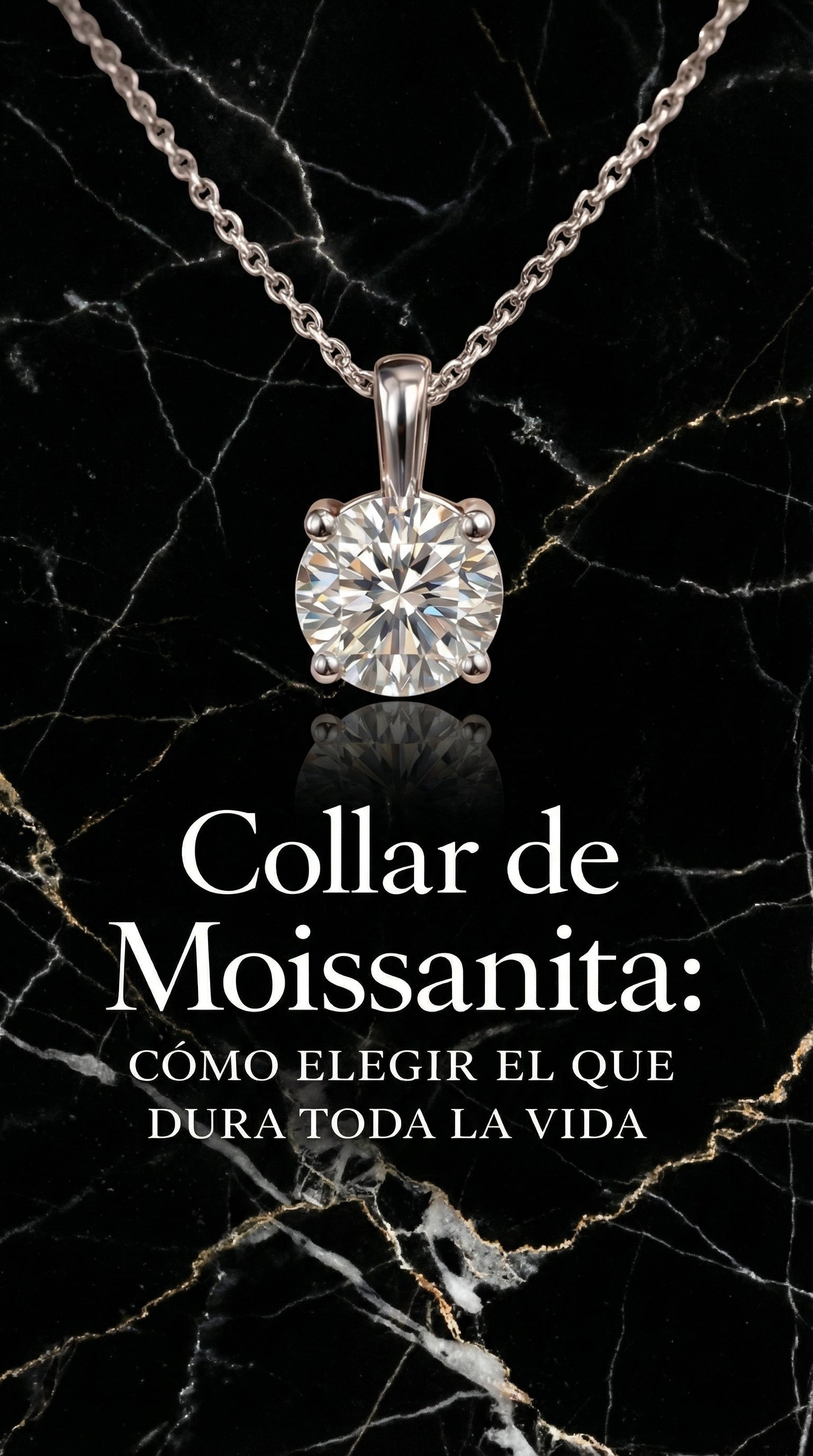
Moissanite vs. diamond: the honest comparison no one is making
Most articles comparing moissanite and diamond are written by someone who sells one of the two. This one isn't. Here is the real comparison, with objective data, without an agenda, and without the sales language that turns an important decision into an act of faith.
The conclusion isn't that one is better than the other. It's that they are different choices, with different reasons. And that those who choose with information choose better.
Brilliance: The Myth to Debunk
The most repeated argument in favor of the diamond is that it sparkles more. This is false, or at least incomplete.
The brilliance of a gemstone is measured by two parameters: the refractive index (how it returns white light) and dispersion or fire (how it separates light into colors). Diamond has a refractive index of 2.42 and a dispersion of 0.044. Moissanite has 2.65 and 0.104 respectively.
Translated: moissanite returns more light and generates more fire — those flashes of color seen when the stone moves. Under artificial light, the difference is visible to the naked eye. Diamond has a whiter, more contained brilliance; moissanite, a more expansive and colorful one. Neither is objectively superior — they are different aesthetics.
Hardness: Practically Identical
Diamond has a hardness of 10 on the Mohs scale — the maximum possible. Moissanite has 9.25. On paper, diamond wins. In real life, the difference is irrelevant for daily use.
Nothing in the daily environment is hard enough to scratch moissanite. Not dust, not other jewelry, not household surfaces. Both stones are practically indestructible under normal use. The diamond's advantage in hardness matters in industrial contexts, not in jewelry.
Price: The Difference That Changes Everything
Here's the fact that most inconveniences the diamond industry: a certified 1-carat moissanite costs 15 to 30 times less than a diamond of equivalent quality.
That doesn't mean moissanite is cheap. It means that the price of a diamond includes decades of marketing, artificial supply control, and a constructed perception of scarcity. Moissanite doesn't have that burden. Its price reflects what it is: an exceptional stone produced with precision technology.
The practical consequence is that with the budget for a 1-carat diamond, you can get a 3 or 4-carat moissanite. The visual impact is radically different. And the quality of the stone is objectively comparable.
Ethics and Environment: The Conversation That Has Changed
Diamond mining has a complicated history: armed conflicts funded by stone sales, questionable labor conditions in African mines, and a significant environmental impact. Kimberley Process certificates attempt to address part of the problem, but their effectiveness is debated.
Laboratory-grown moissanite has none of these problems. It is produced in controlled facilities, without mining extraction, without a conflict footprint. For those who buy with ethical criteria, this is not a minor detail.
Laboratory-grown diamonds also exist and solve the ethical problem. But their price remains significantly higher than moissanite, without optical advantages to justify it.
Identification: Can it be Distinguished by Eye?
No. A gemologist with specialized equipment can distinguish moissanite from diamond using thermal and electrical conductivity tests. To the naked eye, even for experts, the difference is practically imperceptible.
In fact, moissanite fools conventional diamond testers because its thermal conductivity is similar. A specific moissanite tester is needed to distinguish them with certainty.
This is irrelevant for an informed buyer. But it debunks the argument that "you can tell the difference."
When to Choose Diamond
Diamond makes sense when the stone itself is the message. When the symbolic value of the material — its history, its perceived rarity, its cultural weight — is part of what one wants to communicate. For certain marriage proposals, for certain gifts with specific emotional significance, the diamond carries a meaning that moissanite does not yet have in the collective imagination.
It also makes sense as an investment, although the secondary diamond market is much less liquid than the industry suggests.
When to Choose Moissanite
Moissanite makes sense when the stone is the visual protagonist, not the symbol. When maximum optical impact is desired with a budget that doesn't require justification. When buying with aesthetic and ethical criteria, not under the weight of social convention.
And it makes sense when you want a piece that will last for generations — because moissanite, with 9.25 Mohs and stable optical properties, does not age.
The Choice
There is no right answer. There is an informed answer. And the difference between the two is exactly this article.
View the moissanite collection at Silver Status →
Moissanite doesn't compete with diamond. It plays on its own field — and on that field, it wins.