Moissanite: what it is, why it shines brighter than diamond, and why everyone will be talking about it in 2026
Until recently, moissanite was a term only familiar to specialized gemologists and jewelers. Today, it appears in wedding conversations, on birthday wish lists, and in the feeds of those who understand that luxury doesn't have to be justified by an exorbitant price. Something has changed. And it's not a fleeting trend.
This article is not an advertisement. It's an honest explanation of what moissanite is, how it differs from diamond in real terms, and why more and more discerning individuals are choosing it by conviction, not by default.
What is Moissanite
Moissanite is a mineral composed of silicon carbide (SiC) discovered in 1893 by chemist Henri Moissan inside a meteorite that fell in Arizona. The quantity found in nature is so scarce that practically all moissanite on the market today is laboratory-grown—created under controlled conditions that replicate the extreme geological processes that originated it.
That doesn't make it less real. It makes it more consistent. Each stone has the same optical properties, the same hardness, the same behavior when exposed to light. There are no unpredictable quality variations as occur with mined stones.
Why it shines brighter than diamond
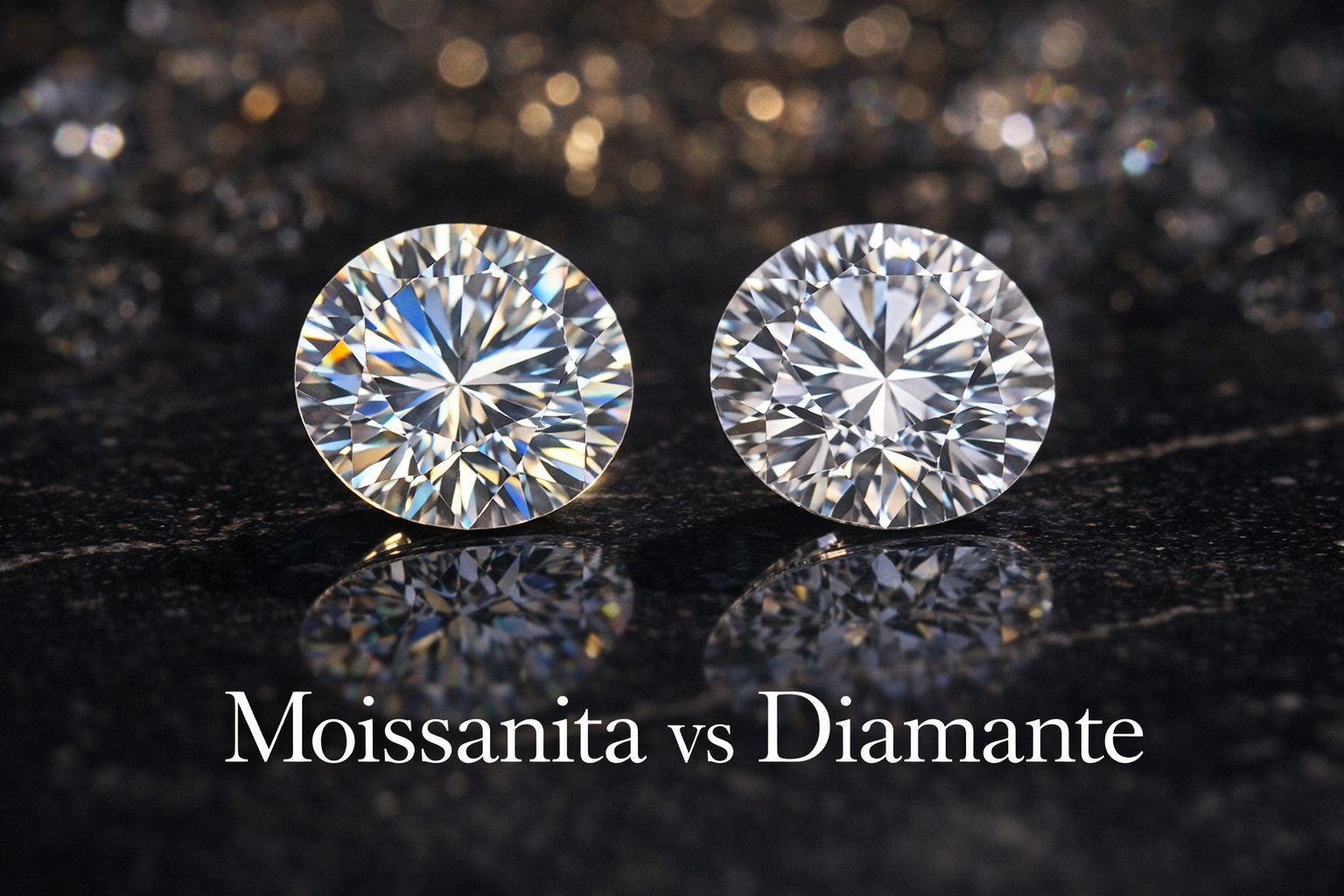
Here's the fact that changes the conversation: moissanite has a refractive index of 2.65. Diamond has 2.42. The refractive index measures how a stone bends and returns light—the higher the index, the more brilliance, more fire, more color in the flashes.
In practical terms: with the same light, moissanite returns more. Its flashes are broader, more colorful, and more visible from a greater distance. This is not an opinion—it's physics.
Diamond has its own type of sparkle: whiter, more contained, more classic. Moissanite has a more expansive sparkle, with more fire (the flashes of color seen when light passes through it). Which is better depends on what one is looking for. But to say that diamond sparkles more is, simply, incorrect.
The comparison in numbers
To understand the difference in objective terms, these are the parameters gemologists use to evaluate a gemstone:
- Refractive Index: Moissanite 2.65 — Diamond 2.42
- Dispersion (fire): Moissanite 0.104 — Diamond 0.044
- Mohs Hardness: Moissanite 9.25 — Diamond 10
- Density: Moissanite 3.21 g/cm³ — Diamond 3.52 g/cm³
Dispersion is the parameter that measures fire—the flashes of color. Moissanite has more than double that of diamond. It's why under artificial light, moissanite is visually more striking.
Hardness: the second hardest stone in existence
The Mohs scale measures a mineral's resistance to scratching. Diamond is the only material with a hardness of 10—the maximum possible. Moissanite has 9.25, making it the second hardest stone in existence, above ruby, sapphire, and any other conventional gemstone.
In terms of daily use, this means that moissanite won't scratch with anything it encounters in everyday life. Not with dust, not with other jewelry, not with hard surfaces. A well-set piece of moissanite lasts generations without losing its original brilliance.
Why everyone is talking about it in 2026
The answer has several layers.
The first is economic: a certified one-carat moissanite costs between 15 and 30 times less than a diamond of equivalent quality. That doesn't mean it's a cheap imitation—it means that the price of diamond includes decades of marketing, supply control, and constructed perception. Moissanite doesn't carry that historical baggage. Its price reflects what it is: an exceptional stone produced with precision technology.
The second is ethical: laboratory-grown moissanite doesn't involve mining extraction, doesn't finance conflicts, and doesn't have the environmental footprint of the diamond industry. For a generation that buys with discernment, this matters.
The third is aesthetic: taste in jewelry has evolved. Minimalism, geometric shapes, and stones with a strong visual presence define 2026 jewelry. Moissanite fits perfectly into that language—it allows for high carat weights at prices that don't require justification.
Certified moissanite: what it means and why it matters
Not all moissanite is created equal. Certification guarantees that the stone has been evaluated by an independent gemological laboratory and that its properties—carat weight, clarity, cut, color—are documented and verified.
At Silver Status, all moissanite pieces include a certificate of authenticity. It's not a decorative document—it's the guarantee that what you're wearing is exactly what is described. Hardness 9.25 Mohs, refractive index 2.65, controlled laboratory origin.
How to choose a moissanite piece
The same criteria that apply to diamond apply to moissanite: cut, color, clarity, and carat weight. Cut is the most important factor—it determines how the stone interacts with light. A brilliant round cut maximizes fire and brilliance. A baguette or oval cut has a more contained, architectural character.
Color in moissanite ranges from D (colorless) to K (slight yellow tint). D-F stones are virtually colorless and the most in-demand. Colored stones—blue, pink, black—are a deliberate aesthetic choice, not a matter of quality.
Carat weight in moissanite is visual: the higher the carat weight, the larger the size and the greater the presence. Unlike diamond, where the price per carat scales exponentially, in moissanite the increase is much more contained—which allows access to large-format stones without budget being the limiting factor.
Moissanite at Silver Status
All Silver Status moissanite pieces are set in solid 925 Sterling Silver with rhodium finishes or yellow gold plating. The combination is not accidental: 925 silver provides the structural base needed for precision settings, and rhodium—the most reflective metal on the periodic table—protects the surface and amplifies the stone's brilliance.
The result is a piece that requires no special maintenance, does not tarnish with normal use, and maintains its original appearance for years. It's not seasonal jewelry. It's jewelry to keep.
View the complete moissanite collection at Silver Status →
Moissanite is not an alternative to diamond. It's a different choice, with its own reasons. Those who choose it know exactly why.